
Scout Moor II Wind Farm: Reasons to Refuse this Application
This template for objections covers both Rochdale Metropolitan Borough Council application 25/00680/FUL (objection deadline 23.10.26) and Rossendale Borough Council application 2025/0267 (objection deadline 28.10.26).
These are substantial, unresolved reasons for refusal, identified through a detailed, document-by-document review of the application. A fully referenced evidence base, over 200 findings with precise citations, is available on request from Friends of the Moorland and the Say No to Scout Moor 2 campaign.
At a glance: six reasons to refuse
- No case for need. No alternative site was ever considered, and the claimed benefits are calculated on less capacity than the permission would actually allow.
- Inappropriate development in the Green Belt, with no Very Special Circumstances that actually justify it.
- Severe and widespread visual and landscape harm, conceded by the applicant’s own assessment as the most severe category available, for multiple communities.
- Permanent, large-scale damage to irreplaceable peatland, including peat depths that breach both Councils’ own adopted policy limits.
- Core technical parameters, turbine size, noise, bridleway safety, remain unfixed, so the assessment itself cannot be relied on.
- Common land rights have not been resolved, and the application has repeatedly been incomplete or inconsistent.
Will committee members even decide this application?
A new National Scheme of Delegation takes effect from 31 October 2026. Large and strategic applications will default to officer delegation. Referral to committee will need the Chief Planning Officer and Committee Chair to agree the application meets a statutory significance test, public objection volume alone will no longer secure one.
We are asking both Councils for written confirmation of how this application will be routed.
1. No case for need has been made
No legal requirement to show need, despite claiming national significance
The applicant admits there is no legal requirement to demonstrate need for renewable energy, while separately claiming national significance for a scheme capped, by design, just below the threshold that would trigger national infrastructure status. No evidence of need is provided.
No alternative site was ever considered
The ‘Consideration of Alternatives’ chapter confirms no comparison was made between this site, a globally rare blanket bog, and any other possible location.
A smaller, less harmful scheme on this same moor was refused in 2017
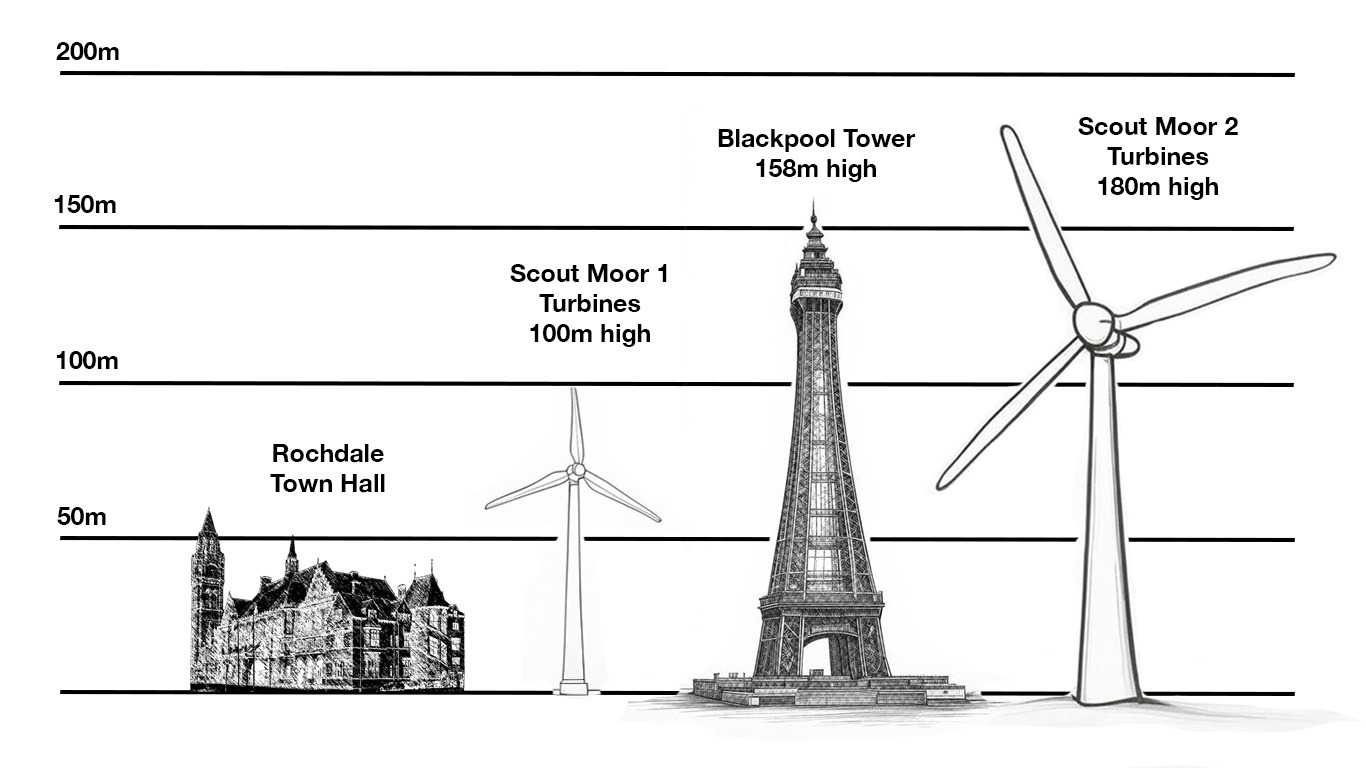
The Secretary of State refused an earlier extension specifically for extending turbines into areas with no current turbines. Scout Moor II repeats this at greater scale (180m to blade tip, against 115m in 2017).
2. Inappropriate development in the Green Belt, with no real Very Special Circumstances
The applicant’s own table concedes substantial harm
The Planning, Design and Access Statement’s own assessment concedes definitional harm (the development is inappropriate by definition), substantial harm to openness, and harm to two of the five Green Belt purposes, all “afforded substantial weight in the planning balance.” The entire case for approval rests on claimed benefits clearly outweighing harm the applicant itself has conceded is substantial.
The benefit case is not tied to this site, and double-counts itself
As set out above, no alternative site was ever considered, so there is no evidence this Green Belt land, rather than land outside it, needs to be used. The same renewable energy benefit is also credited separately under three different headings in the applicant’s own Very Special Circumstances case, inflating its apparent weight without adding any new benefit.
“Temporary and reversible” does not match the applicant’s own decommissioning figures
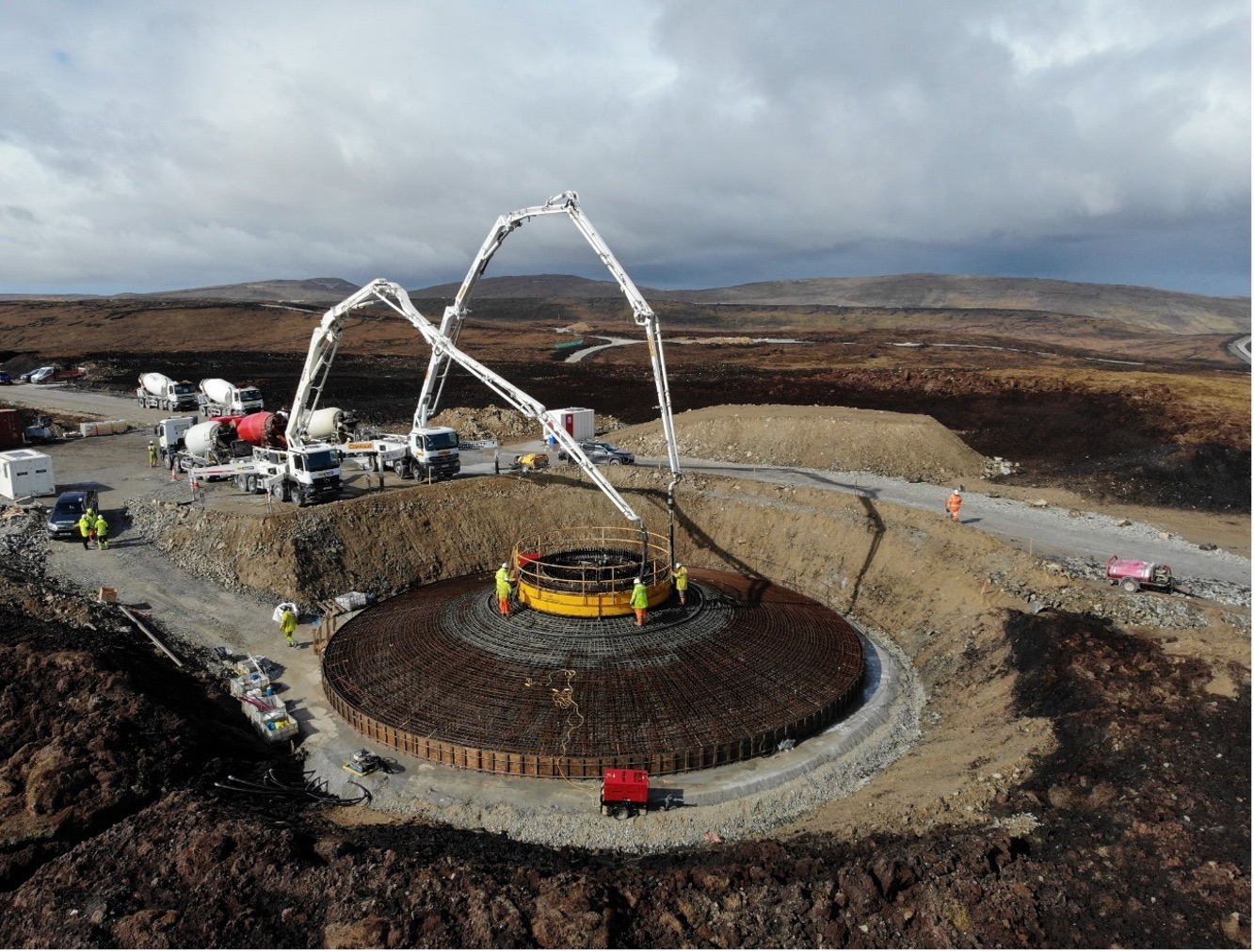
The Green Belt case relies partly on the harm being temporary and fully reversible. As set out below, only the top 1 to 2 metres of each 3.5-metre foundation would be removed, leaving an estimated 11,000 tonnes of concrete in the ground permanently. A scheme that leaves most of its foundations in the ground indefinitely is not temporary or fully reversible.
This same moor has already tested this argument, and lost
In 2017 the Secretary of State refused a comparable extension to the existing Scout Moor Wind Farm. Very Special Circumstances succeeded only for a much smaller, 2-turbine element of that scheme. Scout Moor II’s Green Belt element is materially larger, with a benefit case that has not grown to match it.
3. Severe and widespread visual and landscape harm
The applicant’s own assessment places this in the worst available category
Chapter 11 records “Major adverse and Significant” visual effects, the most severe category in the applicant’s own methodology, for multiple communities including Whitworth, under both the current baseline and the future “restored” baseline once the existing wind farm is eventually removed. For Whitworth, this harm applies now, not only in some future decade. This is not an abstract planning category. It means residents looking out of their own windows, every day, at a view their own council’s assessors have already judged to be the worst this application can do.
The new turbines are conceded to be noticeably larger than the existing ones
The applicant’s own text concedes “a noticeable degree of difference between the height of the proposed… and existing wind turbines,” and that the proposed turbines “would appear greater in scale compared with the existing turbines,” repeated at multiple viewpoints across the application.
Night-time lighting remains Significant even after mitigation
Even with reduced-intensity lighting, Catley Lane Head and Whitworth are assessed as suffering the worst residual night-time lighting category identified anywhere in the application. The reduced lighting scheme itself was approved by the Civil Aviation Authority for a previous, larger 17-turbine layout; the applicant’s own report says this “will be re-submitted” for the current 12-turbine scheme, and no evidence has been provided that this has happened.
The visual evidence provided is, in most cases, not a photomontage
Of 31 residential viewpoints assessed, only one is given a full photomontage; the rest have only a wireline sketch. Specific viewpoints recommended by the Councils’ own commissioned landscape reviewer, and by Bury Council at scoping stage, do not appear in the final application at all.
This repeats harm already found unacceptable on this same moor
In 2017 the Secretary of State refused a comparable extension specifically because the Inspector found the applicant had “understated the likely additive effect” of the existing wind farm when arguing new turbines would not be especially noticeable. The same reasoning appears to have been used again in this application.
4. Permanent, large-scale damage to irreplaceable peatland
The peat on this moor began forming thousands of years ago. It cannot be recreated, replanted, or restored on any timescale that matters to a planning decision. Once it is dug up and permanently contaminated by buried concrete, it is gone, not for 40 years, but for good.
The scale of ground disturbance
• 96,674 cubic metres of peat excavated, the Environmental Statement’s own “worst case” figure (Chapter 14), covering foundations, tracks and earthworks.
• A further estimated 24,500 cubic metres disturbed by on-site cabling, not stated anywhere in the application.
19,530 tonnes of concrete would remain in the moor forever
Only the top 1 to 2 metres of each approximately 3.5-metre foundation would be removed at decommissioning. On that basis, we estimate in the order of 11,000 tonnes would remain permanently, outlasting the 40-year operational life with no plan to ever remove it. This is not a 40-year project. Everyone reading this letter, their children, and their grandchildren, will be gone before anyone is under any legal obligation to take this concrete out of the ground, because no one ever will. What is approved now would still be there in 200 years, causing ongoing damage to the natural environment.
The chemical risk is conceded three times for construction, and addressed zero times for the permanent condition
• Concrete is conceded as highly alkaline and able to affect water quality.
• The ground is conceded as acidic enough to require a protective concrete mix.
• pH change is conceded as capable of causing high magnitude harm to peat.
No chapter assesses what thousands of tonnes of permanently buried alkaline concrete will do to the surrounding acidic peat over decades. An Environmental Statement must assess direct, indirect, secondary and cumulative effects, not only the construction phase. This is a fundamental gap.
The application’s own figures breach the adopted peat-depth policy test
Rossendale’s Policy ENV7 and Rochdale’s Policy G3 both prohibit development on peat over 40cm deep. Natural England and Defra now treat 30cm as the threshold for deep peat. The Environmental Statement records depths up to 3.7m at this site, with no turbine-by-turbine compliance check provided.
Rochdale’s own emerging Local Plan agrees
The Council’s August 2026 Climate Change and Flood Risk Topic Paper states that further large-scale wind development in this part of the borough carries “issues around environmental impacts in particular in relation to peat, and in terms of landscape impacts.”
An independent climate refuge sits adjacent to the proposed turbines
A Lancashire Wildlife Trust-commissioned study recommends a specific area of Rooley Moor be safeguarded from development, containing some of the deepest peat in England per the 2025 Natural England Peat Map.
The heritage and benefit conclusions are easy to misread
Every heritage effect in Chapter 12’s own summary table is marked “Not Significant”, including Moderate adverse effects on two Conservation Areas and several listed buildings, while the same harms are separately given substantial weight elsewhere in the applicant’s own planning balance.
The operational job figures are a small fraction of what they suggest
On the applicant’s own modelling, fewer than two full-time-equivalent jobs are created UK-wide during the 40-year operational phase. 40 to 45 person-years over 40 years works out to roughly 1 permanent local job.
5. Core technical parameters remain unfixed
No maximum rotor diameter or hub height
The application gives three different rotor diameter figures (149m, 150m and 163m) for the same candidate turbine, with no binding maximum. Every noise and landscape conclusion rests on a specification the permission itself does not actually fix.
Amplitude modulation noise has not been assessed before consent
Enforcement would rely on residents complaining after construction, with no continuous, independent monitoring.
Shadow flicker and equestrian safety have not been properly assessed
The applicant’s own figures put the nearest turbine only around 12 metres inside the British Horse Society’s safety margin for the Pennine Bridleway, a margin the unconstrained 50m micro-siting allowance could remove entirely.
6. Common land rights are being bypassed
No application to deregister the common land
This has not been made despite permission being sought now, and the draft Section 106 agreements for both Councils contain no obligation to secure it. The land is Section 193 common land, over which the public holds a statutory right of access. If deregistration is later refused, the scheme cannot legally proceed to construction regardless of planning permission.
The 50m micro-siting allowance is looser than every precedent at this site
A legal advice note, released only after repeated requests, shows the original 2008 consent allowed 40m, and recommended conditions in 2015 and 2017 allowed only 30m, both with safeguards (no footprint increase, named turbines barred from moving closer to sensitive routes) that this application lacks.
The application has repeatedly been incomplete or inconsistent
Superseded chapters have remained on the portal, the legal advice note above was withheld for months, and figures for the same parameters conflict across different application documents.
In conclusion
These are substantial, unresolved reasons for refusal, not a list of items for the applicant to tidy up before a decision is otherwise waved through. Once this permission is granted, there is no undoing it. The concrete does not come back out. The peat does not reform. The view from Whitworth does not return to what it was. We are not asking committee members to find a reason to delay an inevitable decision. We are asking them to recognise that, on the applicant’s own evidence, the case for inflicting this harm has not been made, and should not be waved through on the assumption that someone else, at some later stage, will sort it out.
We ask committee members and councillors to object to this application, and to require the applicant to resolve these matters before any further consideration is given, rather than treat them as conditions to be discharged after permission is granted. We, the Friends of the Moor, and the Say No to Scout Moor 2 campaign would welcome the opportunity to brief members in more detail.
Illustrations
The proposed turbine height (180m) relative to Rochdale Town Hall, the current Scout Moor turbines (100m), and Blackpool Tower. The proposed turbines are almost twice the height of the current Scout Moor turbines.
The scale of the foundations, and how they would permanently alter the moorland environment.
How to use
You can copy and paste from the post above or download a Word document Scout Moor II Wind Farm – Reasons to Refuse this Application.